ACA, ACCA, AAT or Unqualified? What Your Accountant’s Letters Actually Mean, and Why Their Fees Differ
Admin
June 20, 2026
0 Comments
If you have ever compared quotes from three different accountants and wondered why one charges double what another does for what appears to be the same job, the answer usually comes down to qualifications.
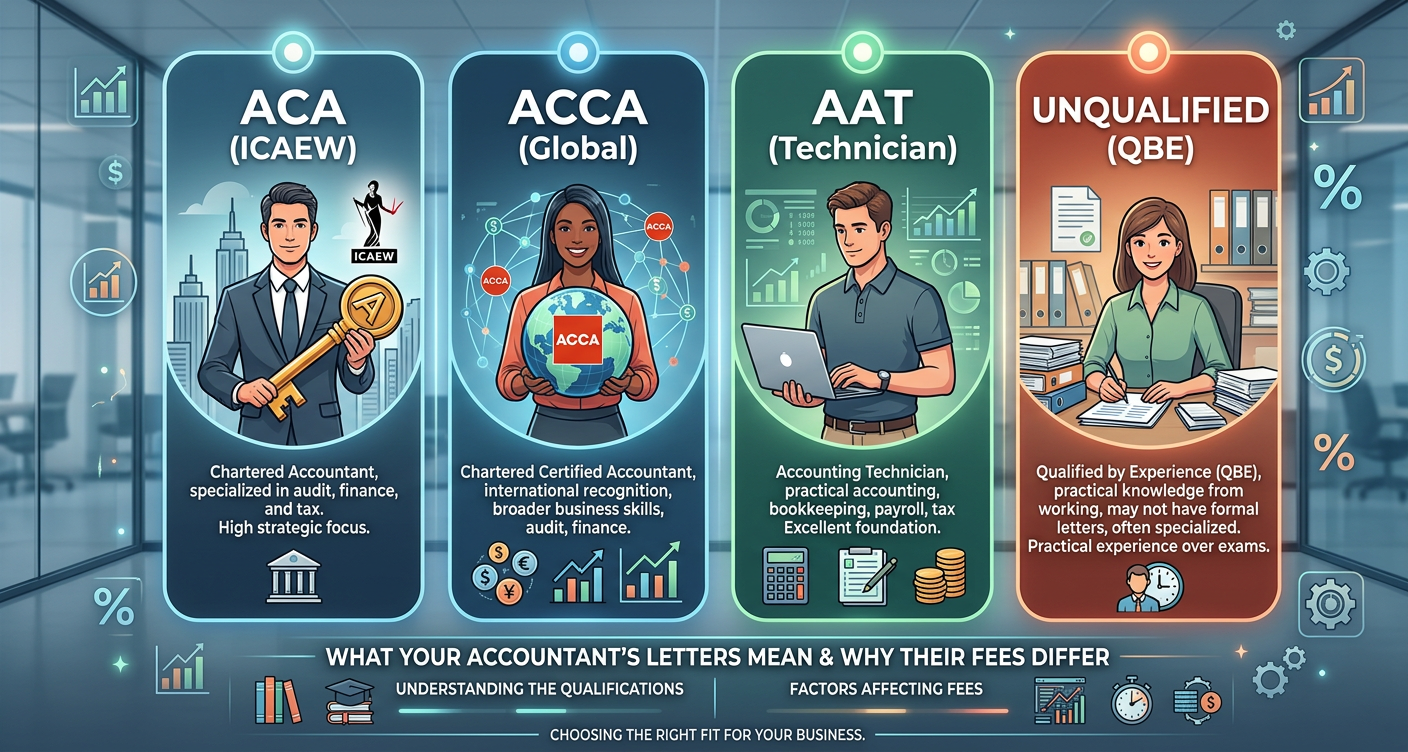
Anyone in the UK can legally call themselves an “accountant” without any formal training, as the title itself is not protected by law. What is protected, and what genuinely separates one practice from another, is membership of a recognised professional body. Here is what each one actually means.
The Chartered Tier: ICAEW and ICAS
ICAEW (Institute of Chartered Accountants in England and Wales) and ICAS (Institute of Chartered Accountants of Scotland) sit at the top of the profession.
Qualifying as an ACA or CA involves a three-year training contract alongside fifteen professional examinations covering audit, tax, law, financial reporting and ethics. These are the only two bodies in the UK whose members can be licensed to sign statutory audits.
Because of this, ICAEW and ICAS firms are required to hold professional indemnity insurance, are directly supervised for anti-money laundering compliance, and are accountable to a formal disciplinary body.
That regulatory weight is reflected in their fees. Clients are not simply paying for technical knowledge; they are also paying for the accountability and oversight that sit behind it.
ACCA: Chartered Certified, Global Reach
ACCA (Association of Chartered Certified Accountants) is an international body with a similarly demanding syllabus, although entry is more flexible than the traditional training contract route.
ACCA members can also obtain audit rights once additional practical requirements have been met. Standards and regulation are broadly comparable to those of ICAEW and ICAS, and fees tend to sit within a similar range, sometimes marginally lower at partner level depending on the firm.
Specialist Bodies: CIMA and CTA
CIMA (Chartered Institute of Management Accountants) trains accountants for internal, management-focused roles involving budgeting, costing and strategic reporting, rather than statutory compliance work.
CIMA members are therefore less commonly found in general practice and do not typically influence a firm's fee structure for tax or accounts compliance work.
CTA (Chartered Tax Adviser), awarded by the Chartered Institute of Taxation, is the opposite case. It is a specialist qualification that is usually undertaken in addition to ACA or ACCA.
It is widely regarded as the gold standard for complex tax advisory work, and firms often charge a premium for CTA-led services such as restructurings, tax relief planning and HMRC enquiries.
AAT: The Technician Level
AAT (Association of Accounting Technicians) qualifies bookkeepers and accounting technicians rather than chartered accountants.
AAT-qualified staffs are well suited to routine compliance work such as bookkeeping, VAT returns and basic accounts preparation, which is reflected in lower hourly rates. However, it is not a substitute for chartered-level advisory or audit work.
CPA: A Foreign Equivalent
CPA (Certified Public Accountant) is the principal professional qualification in the United States.
It is generally only relevant to a UK client where there is a US dimension involved, such as US GAAP reporting or US tax filings. A CPA designation alone does not confer any regulatory standing in the UK.
No Professional Body at All
This is the category that warrants the greatest caution.
Because “accountant” is not a protected title, some practitioners operate without belonging to any of the professional bodies mentioned above. They are not required to hold professional indemnity insurance, are not bound by a professional code of ethics or continuing professional development requirements, and are not subject to a disciplinary process if something goes wrong.
They must still register directly with HMRC for anti-money laundering supervision, but this is a significantly lower level of oversight than that provided by a chartered professional body.
Fees in this category are often the lowest in the market, but the risks to clients are generally higher.
Training and Background Matter Just as Much as the Letters
Two accountants holding the same qualification can still provide very different levels of advice, because professional examinations merely establish the entry standard.
What truly shapes the advice a client receives is where that individual trained and the experience they gained afterwards.
At Consultax Chartered Accountants, our lead partner, Varun Gupta, is ACA qualified through ICAEW. He trained at PwC across Assurance and Business Advisory Services before spending almost a decade in investment banking with UBS and BNP Paribas, working across market risk, product control and valuation. He later moved into industry as a Finance Director.
That background brings a different perspective to client work: combining structuring, risk management and commercial judgement developed within some of the most heavily scrutinised environments in finance, and applying them directly to the challenges clients face.
It is one of the reasons why the conversations clients have with us often differ from those they might have with a lower-tier or unregulated accountant working solely from textbook knowledge.
What This Means When You Are Comparing Quotes
Price differences between accountants are rarely arbitrary. They generally reflect three factors:
· The rigour of the qualification
· The level of regulatory oversight behind it
· The complexity of the work involved
Before engaging an accountant, it is worth checking three things:
1. Which professional body they belong to
2. Whether they hold professional indemnity insurance
3. Whether they are supervised for anti-money laundering compliance through a professional body or directly by HMRC
At Consultax, our team is ACA qualified through ICAEW, meaning every engagement benefits from the full regulatory backing that comes with chartered status.
If you would like to discuss your accounting or tax position with a chartered firm, please get in touch.

Category:
Accounting
Tags:
Expert Accountant, Finance
Comments (0)
No comments yet. Be the first to comment!
Leave Comment