Difference Between Tax Year vs Financial Year for UK Businesses in 2026/27
Admin
July 8, 2026
0 Comments
If you have ever found yourself checking two different dates before submitting a return, you are not alone. Many UK business owners use the terms tax year and financial year interchangeably, yet they mean quite different things to HMRC. Understanding the distinction is not just a matter of terminology; it affects when you file, what you pay, and how smoothly your accounting runs throughout the year.
This guide explains exactly what separates the tax year from the financial year, why the difference matters for sole traders, landlords and limited companies, and how choosing the right accounting period can make life considerably easier when deadlines start to close in.
What Is the UK Tax Year?
The UK tax year, sometimes called the fiscal year, is a fixed 12-month period set by HMRC for personal taxation.
· It always runs from 6 April to 5 April of the following year.
· The 2026/27 tax year runs from 6 April 2026 to 5 April 2027.
· The tax year applies to:
Ø Income Tax
Ø National Insurance Contributions (NICs)
Ø Capital Gains Tax (CGT)
Ø Self-assessment for sole traders, partnerships, landlords, and company directors.
· Personal allowances, ISA limits, and dividend thresholds reset on 6 April each year.
· Unused tax allowances expire at the end of the tax year and cannot be carried forward.
· The 6 April start date is due to historical calendar changes, not tax policy.
The Historical Quirk
The reason for this unusual start date sits in history rather than logic. When Britain adopted the Gregorian calendar in 1752, eleven days were removed to correct a long-standing drift from the Julian calendar. To avoid losing a full year of tax revenue, the Treasury shifted the year-end from 25 March to 5 April, and a further calendar correction in 1800 pushed it to 6 April, where it has remained ever since.
What Is a Financial Year?
A financial year (also called an accounting period) is a 12-month cycle used by a company to prepare:
· Annual accounts
· Profit and loss statements
· Balance sheets
· Unlike the UK tax year, a company's financial year is not fixed by law.
· A limited company can choose its own financial year-end, provided it is registered with Companies House.
Many businesses choose:
· January - December to match the calendar year.
· April - March to align with the UK government's financial year.
Some businesses choose year-ends that suit their operations:
· Retailers often choose 31 January after the Christmas trading period.
· Tourism businesses may choose 30 September after the summer season.
In a government context, Financial Year (FY) has a specific meaning:
· It runs from 1 April to 31 March.
· It is used by HM Treasury and HMRC for public spending and setting Corporation Tax rates.
Government financial years are named after the year they begin.
· Example: 1 April 2026 – 31 March 2027 is called FY2026 (Financial Year 2026).
Key Differences Between Tax Year and Financial Year
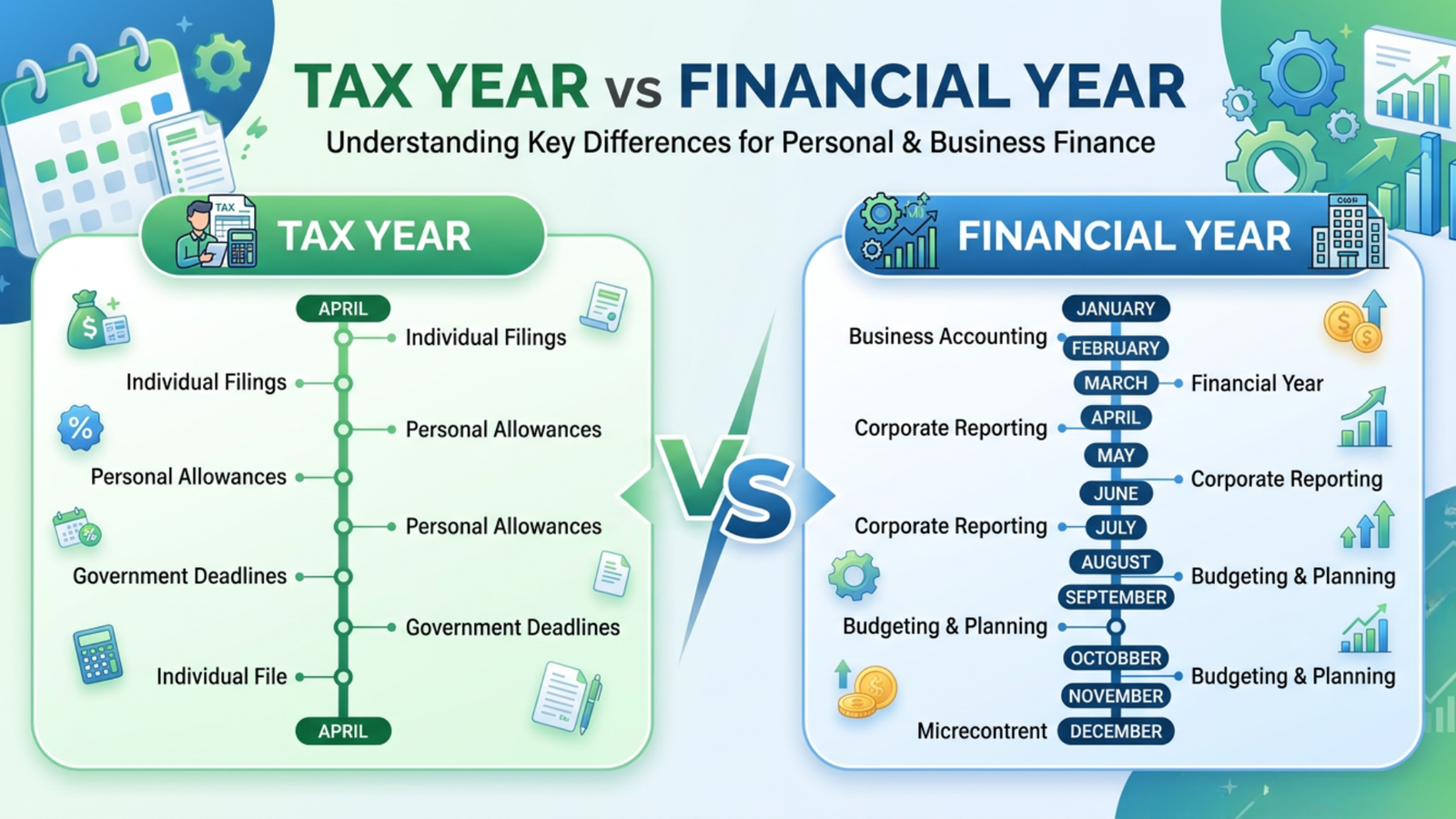
The clearest way to separate the two terms is by purpose. The tax year tracks what an individual or unincorporated business owes HMRC in personal tax; the financial year tracks how a company or organisation is performing and reports its results.
Fixed vs flexible: The tax year always runs 6 April to 5 April. A company's financial year can end on almost any date the business chooses.
Who it applies to: The tax year governs Income Tax, National Insurance, and Capital Gains Tax for individuals, sole traders, and partnerships. The financial year governs a limited company's statutory accounts and, in the government's usage, Corporation Tax rates.
Reporting obligations: Self-assessment tax returns follow the personal tax year. Annual accounts filed at Companies House follow the company's own financial year.
Historical origin: The 6 April start of the tax year stems from the 1752 calendar reform, while the 1 April government financial year was adopted later for administrative convenience.

Why the Distinction Matters for UK Businesses
For sole traders and landlords, the tax year is largely non-negotiable. Every pound of profit, rental income, or dividend received between 6 April and 5 April falls into that year's tax calculation, and self-assessment returns must reflect it accordingly.
Limited companies face a slightly more layered picture. Corporation Tax is charged by reference to the government's financial year running 1 April to 31 March, while the company's own accounting period may run to a different date entirely. For the 2026/27 financial year, companies with taxable profits up to £50,000 continue to pay the small profits rate of 19 per cent, profits above £250,000 are taxed at the main rate of 25 per cent, and profits falling between these thresholds benefit from marginal relief, calculated using the standard fraction of 3/200, which tapers the effective rate smoothly between the two bands.
Where a company's accounting period straddles two financial years with different rates, profits must be apportioned on a daily basis between them, adding an extra layer of calculation that most businesses would rather avoid. This is precisely why many owner-managed companies choose a 31 March or 5 April year-end: it keeps the accounting period neatly inside a single financial year and avoids unnecessary apportionment.
Payroll adds a further consideration. Regardless of when a company's financial year falls, PAYE, employee National Insurance, and P60 documents are always reported against the 6 April to 5 April tax year through Real Time Information submissions to HMRC. Employers must also remember that P11D forms for benefits in kind follow the same tax year cycle and carry their own filing deadlines each July.
The 2026/27 tax year has brought a significant shift for many small businesses, too. Making Tax Digital for Income Tax self-assessment became mandatory from April 2026 for sole traders and landlords with qualifying income above £50,000, meaning manual record-keeping is no longer sufficient. Affected businesses must now use compatible software to keep digital records and submit quarterly updates to HMRC throughout the tax year.
How to Choose the Right Financial Year End for Your Business
There is no single correct answer, but a few principles help most businesses decide.
· Simplicity: Aligning your financial year with 31 March or 5 April keeps your accounts inside one tax year and one set of Corporation Tax rates, reducing apportionment and administrative work.
· Seasonality: Businesses with a clear seasonal pattern, such as retail or tourism, often benefit from a year-end that falls just after their busiest trading period, giving the finance team breathing room to close accounts properly.
· Group and investor reporting: Companies reporting to an overseas parent or preparing for investment may choose a year-end that matches the reporting cycle expected by stakeholders.
· Consistency: Once a financial year end is set, it should generally be kept consistent. Changing it requires notifying Companies House, and a change is only permitted under certain conditions, including limits on how often the accounting period can be extended.
Key Dates to Remember for 2026/27
· 6 April 2026 – The 2026/27 tax year begins; personal allowances and tax bands reset.
· 1 April 2026 to 31 March 2027 – The government's financial year (FY2026) for Corporation Tax purposes.
· 31 July 2026 – Second payment on account due for self-assessment.
· 31 October 2026 – Paper self-assessment tax return deadline.
· 31 January 2027 – Online self-assessment deadline and the balancing payment date for the 2025/26 tax year.
· 5 April 2027 – The 2026/27 tax year ends.
How Can Consultax Help?
Juggling the tax year, the financial year, and HMRC's PAYE cycle can feel overwhelming when you are running a business single-handedly. This is why so many sole traders, landlords, and limited company directors turn to a chartered accountancy firm like Consultax.
Our simpler process:
|
Service |
Why It Matters |
|
Accounting and book-keeping support |
All your income, expenses, and records kept in one place, mapped clearly against the correct tax year or accounting period, so nothing gets lost between the two. |
|
Tax support |
No second-guessing which deadline applies. Stay on top of self-assessment, Corporation Tax, and payroll with confidence, whichever year-end your business follows. |
|
Professional accountants |
Got a question about your financial year end or Corporation Tax rate? Your dedicated adviser, led by partner Varun Gupta ACA, whose experience spans PwC, UBS, BNP Paribas, and a Finance Director role in industry, keeps your tax year and financial year in sync. |
|
Compliance made easy |
RTI submissions, annual accounts, marginal relief calculations, and Making Tax Digital requirements, all handled without the last-minute scramble. |
So whether you are a sole trader, a landlord, a limited company, or a mix of all three, Consultax's ICAEW-regulated team can help you stay organised, compliant, and clear on exactly which year applies to what.
Conclusion
Though the tax year and financial year are often mentioned in the same breath, they serve distinct purposes within the UK's tax system. The tax year is fixed, running from 6 April to 5 April, and governs personal tax obligations for individuals and unincorporated businesses. The financial year, by contrast, is a period a company chooses for its own accounts, while also carrying a separate meaning as the government's 1 April to 31 March cycle for Corporation Tax. Getting to grips with both, and understanding how they interact, is one of the simplest ways to keep your business compliant, avoid unnecessary apportionment, and plan your finances with confidence.
Keep Your Tax Year and Financial Year on Track
Let Consultax simplify your tax planning and compliance. From self-assessment and corporation tax to payroll deadlines, we will help you stay organised and avoid costly mistakes.
Book a MeetingCategory:
Taxation
Tags:
Tax Filing, Taxation
Comments (0)
No comments yet. Be the first to comment!
Leave Comment