How Specialist Accountants Help UK Forex Traders Stay HMRC-Compliant
Admin
July 21, 2026
0 Comments
Forex trading has become one of the most accessible ways for UK residents to speculate on global financial markets, but the tax treatment attached to it is anything but simple. Whether you trade spot currency pairs, use contracts for difference (CFDs), or place spread bets through platforms such as MT4, MT5 or cTrader, HM Revenue & Customs (HMRC) does not apply a single, uniform rule to your profits. Instead, your tax position depends on how you trade, how often, and how HMRC classifies your activity.
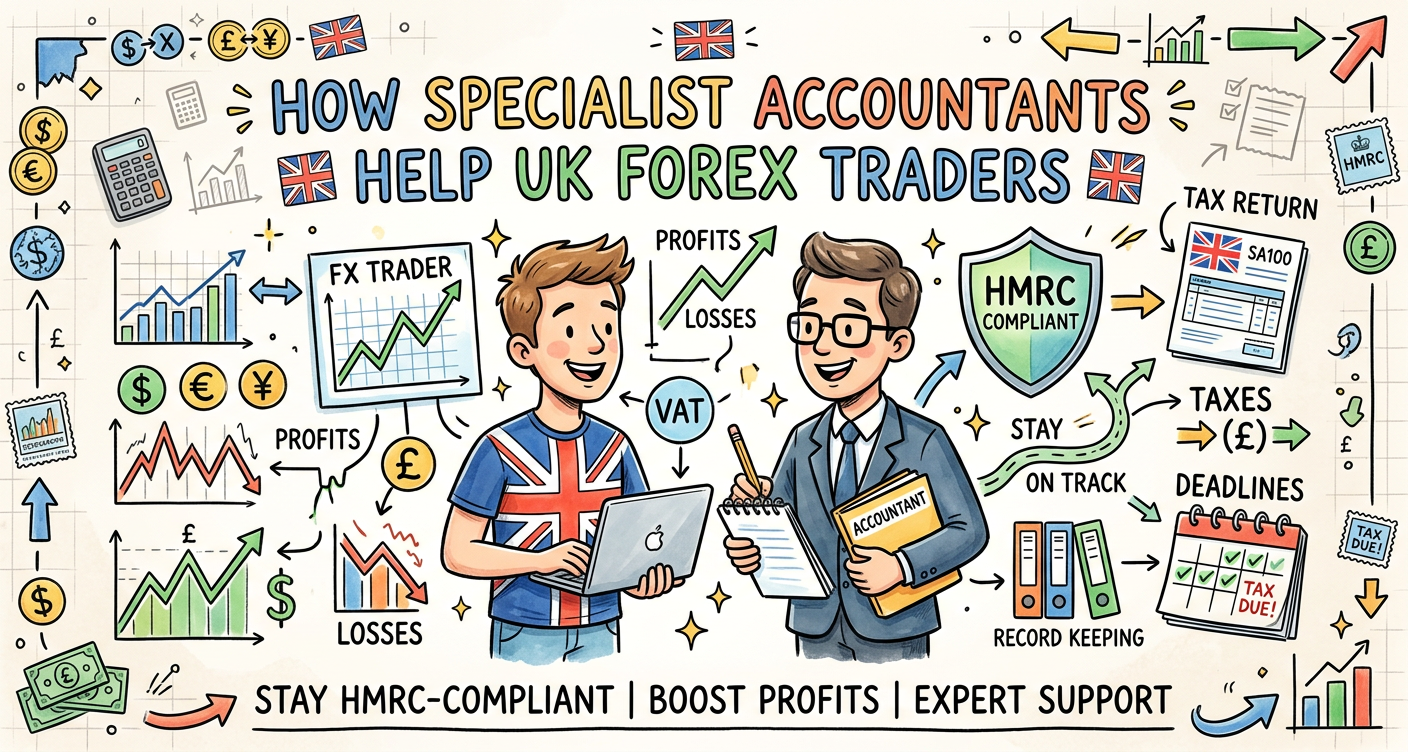
For this reason, a growing number of traders are turning to a specialist forex trading accountant rather than relying on generic book-keeping software or a high-street accountant unfamiliar with broker statements, multi-currency conversions and offshore reporting obligations. This article explains why forex tax in the UK is so easy to get wrong, what has changed for the 2026/27 tax year, and how working with experienced accountants for forex traders such as Consultax Chartered Accountants helps you stay compliant while keeping more of what you earn.
Why Forex Tax in the UK Is More Complicated Than It Looks
HMRC does not have a bespoke tax category for forex trading. Instead, it applies existing frameworks depending on the nature of the activity, which means two traders using identical strategies can end up with entirely different tax bills.
Broadly, three outcomes are possible:
• Spread betting is treated as gambling rather than investing, so profits generally fall outside both Capital Gains Tax (CGT) and Income Tax for most retail traders. The trade-off is that losses cannot be offset against other income or gains.
• CFD and spot forex trading profits are usually assessed under the Capital Gains Tax regime, above the annual exempt amount of £3,000 for the 2025/26 tax year, with rates depending on your other income.
• Where trading is frequent, high in volume, and effectively your main source of income, HMRC may apply the ‘badges of trade’ test and treat you as running a business. In that case, profits are taxed as trading income, potentially at 20%, 40% or 45%, with Class 4 National Insurance also due.
There is no single threshold that triggers business classification; HMRC looks at the whole picture, including frequency of trades, organisation, the degree of risk taken, and whether trading is your primary occupation. This is precisely the kind of judgement call that benefits from professional input, since getting the classification wrong at the outset can lead to an incorrect filing position that is difficult to unwind later.
What's Changed for UK Forex Traders in 2026
Several developments this year make specialist advice more valuable than ever for active traders:
• Making Tax Digital for Income Tax has begun rolling out for the self-employed and landlords with qualifying income above £50,000 from 6 April 2026, with the threshold falling to £30,000 from April 2027 and £20,000 from April 2028. Traders, who are classified as running a trading business rather than investing personally, need to consider how these digital record-keeping and quarterly reporting duties apply to them.
• HMRC's ability to cross-check offshore broker activity has strengthened considerably. Under the Common Reporting Standard, financial institutions and trading platforms in more than 100 jurisdictions now share account information with HMRC, meaning offshore brokers used for forex trading are far less likely to go unnoticed.
• CGT rates on assets outside the Business Asset Disposal Relief regime raised following the October 2024 Budget, increasing the cost of getting CFD and spot forex profit classification wrong.
Taken together, these changes mean that traders who once relied on informal spreadsheets or assumed their offshore broker was invisible to HMRC are taking on considerably more risk than they may realise.
How Consultax Chartered Accountants Adds Value for Forex Traders
1. Correct classification from the outset
Before any figures are prepared, a specialist forex trading accountant will assess whether your activity is more accurately treated as investment, trading, or gambling for tax purposes. This single decision determines which tax regime applies, whether losses can be carried forward, and what records HMRC will expect to see if your return is ever queried.
2. Reconciling broker and platform data
Exports from MT4, MT5, cTrader and similar platforms rarely translate cleanly into a UK tax return. Swaps, commissions, overnight financing charges, deposits, withdrawals and bonus credits are often mixed together, and profits are typically shown in US dollars or euros rather than sterling. Consultax reconciles this raw data into a clear schedule of trading results converted to GBP using an appropriate and defensible basis, which is essential if HMRC ever asks how a figure was reached.
3. Managing losses properly
Periods of loss are a normal part of forex trading. Consultax Chartered Accountants helps ensure losses are recorded and reported correctly so that, where permitted under UK tax rules, they can be offset or carried forward. Proper record-keeping from the outset helps prevent valuable tax relief from being lost.
4. Advising on limited company structures
For consistently profitable traders, operating through a limited company can offer advantages around retained capital and corporation tax planning, though it also introduces director loan considerations, extraction planning and additional filing obligations. Consultax reviews profit levels, trading frequency and personal circumstances before recommending incorporation, rather than assuming it is automatically the better option.
5. Supporting international and offshore positions
Many UK-resident traders use brokers based in Cyprus, Dubai or elsewhere, sometimes assuming that an offshore platform removes any UK reporting obligation. It does not. If you are a UK tax resident, your worldwide trading income and gains generally need to be considered for UK reporting, and a specialist accountant will assess this alongside the Statutory Residence Test where relevant.
6. Standing behind you in an HMRC enquiry
If HMRC opens an enquiry into trading income, Consultax Chartered Accountants can represent you throughout the process. With experience in broker reporting, foreign currency conversions, and the tax treatment of forex trading, the firm prepares structured working papers, supporting evidence, and clear explanations to help resolve enquiries efficiently and minimise the risk of penalties.
Record-Keeping Every Forex Trader Should Maintain
Regardless of which accountant you use, HMRC expects to see evidence, not estimates. At a minimum, traders should retain:
• Full broker statements covering trades, deposits, withdrawals, swaps and commissions for each tax year
• A reconciliation showing how foreign currency results were converted to sterling
• A record of the trading method used (spread betting, CFDs or spot forex) for each account
• Evidence supporting any claimed business expenses, such as data feeds, platform subscriptions or a trading workstation
• Copies of previous Self-Assessment returns and any HMRC correspondence
Traders who keep these records from day one, rather than reconstructing them at year-end, generally find the filing process considerably faster and less stressful, and are in a far stronger position if HMRC ever raises questions.
Consultax Chartered Accountants: Regulated Support for UK Traders
Consultax Chartered Accountants is an ICAEW-regulated firm led by partner Varun Gupta ACA, whose career spans PwC, UBS and BNP Paribas, alongside direct experience as a Finance Director. This blend of Big Four rigour and institutional financial services grounding gives Consultax a genuine edge when working with forex traders. Hiring Consultax gives UK forex traders:
• Correct classification from the outset - trading activity is assessed properly against HMRC's rules before any figures are prepared, reducing the risk of a flawed filing position later.
• Accurate broker reconciliation - multi-currency exports from MT4, MT5, cTrader and similar platforms are reconciled with precision, reflecting the same rigour applied to institutional trading data.
• Evidence-backed Self-Assessment returns - filings are supported by clear working papers, not estimates, so figures can be defended if HMRC ever asks how they were reached.
• ICAEW-regulated guidance on limited company structuring - advice on incorporation carries professional accountability, weighing up corporation tax, extraction and admin considerations rather than assuming a company is automatically better.
• Represented support during HMRC enquiries - traders are not left to respond alone, with a regulated firm presenting structured evidence on their behalf.
• Protection of trading losses - proper classification and record-keeping ensure losses are preserved and usable rather than lost through poor documentation.
Together, this means fewer costly classification errors, stronger protection of trading losses, and a tax position built to withstand scrutiny rather than assembled after the fact.
Conclusion
Forex trading tax in the UK is governed by classification, evidence and timing, and the margin for error is smaller than many traders assume. As HMRC's access to broker and offshore data continues to expand in 2026, informal record-keeping is an increasingly risky approach for anyone trading with any regularity. Working with an experienced forex trading accountant does not just simplify the annual filing; it protects losses, supports sound structuring decisions and provides a clear defence should HMRC ever ask questions. For UK forex traders who want that certainty, partnering with regulated accountants for forex traders such as Consultax Chartered Accountants offers a dependable route to staying compliant while focusing on what matters most: trading well.
Stay Ahead of Your Forex Trading Taxes
CCA provides expert tax support for forex traders, making compliance simple, accurate, and hassle-free.
Book a MeetingCategory:
Taxation
Tags:
Business, Taxation
Comments (0)
No comments yet. Be the first to comment!
Leave Comment