Payments on Account: Everything You Need to Know 31 July Tax Deadline
Admin
June 26, 2026
0 Comments
If you are registered for Self-Assessment, there is a very good chance you have come across the term 'payments on account', and, equally likely, it caught you off guard the first time you saw it on your tax bill. You are certainly not alone. For sole traders, freelancers, landlords, and company directors receiving untaxed income, payments on account are one of the most misunderstood aspects of the UK tax system.
This guide explains exactly what payments on account are, who has to make them, how they are calculated, when the deadlines fall, how to pay HMRC, and what happens if your circumstances change. Whether you are preparing for the 31 July 2026 deadline or planning ahead for January 2027, read on.
What Are Payments on Account?
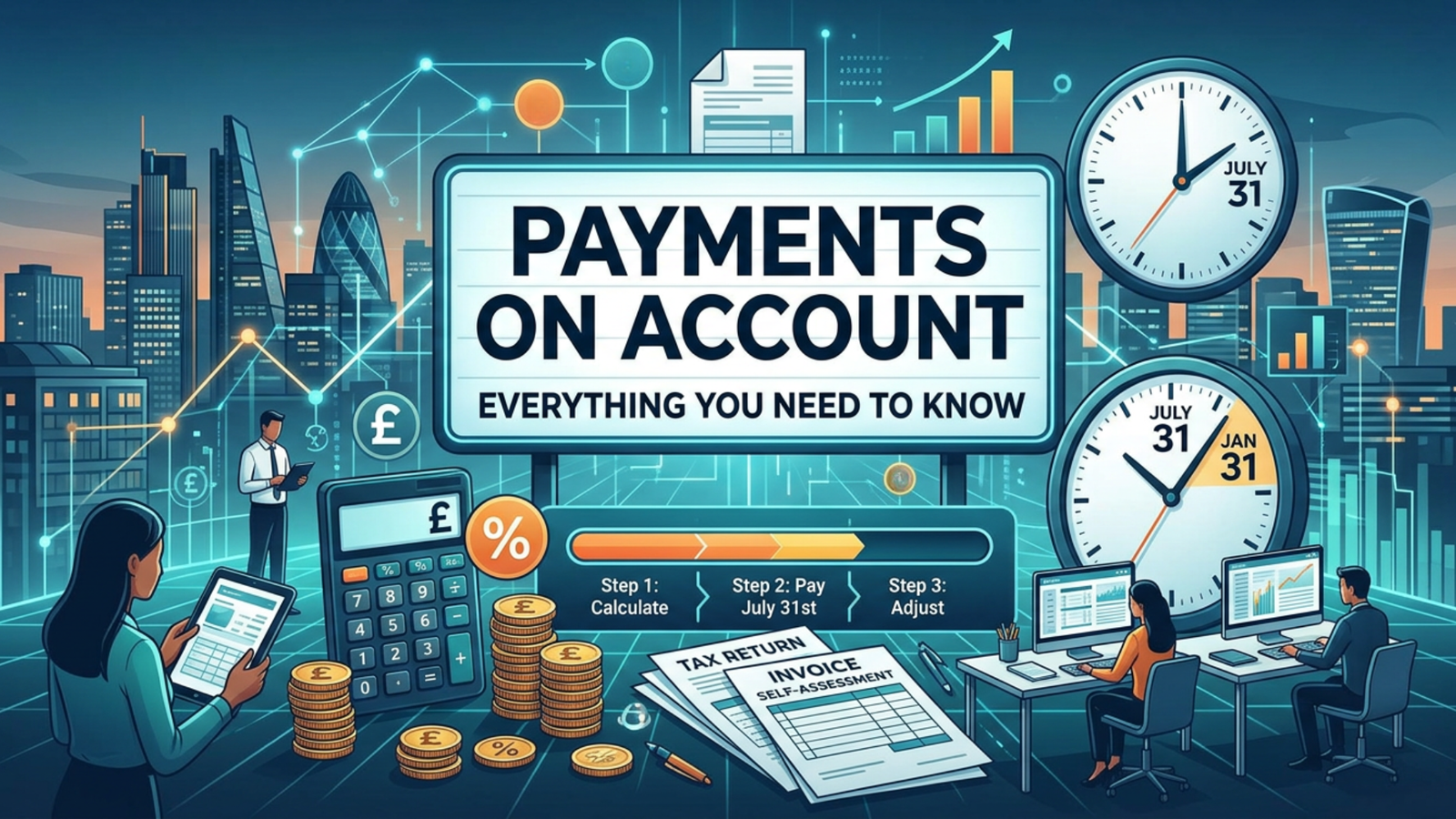
Payments on account are advance payments made towards your next Self-Assessment tax bill. Rather than waiting until January each year to collect all of the tax you owe in a single lump sum, HMRC asks most Self-Assessment taxpayers to pay their estimated tax liability in two instalments spread across the year.
The logic behind the system is straightforward: HMRC assumes your income in the current tax year will be broadly similar to the previous tax year. It therefore asks you to pay, in advance, an amount equivalent to your prior year's tax bill, split into two equal halves. Once you have filed your return and the real figure is known, HMRC compares what you have already paid against what you actually owe and either issues a refund or asks for a further balancing payment.
Key point: Payments on account are not extra tax. They are advance payments that are offset against your eventual bill. The amount you pay across the year should, in theory, closely match what you owe.
Who Has to Make Payments on Account?
You are required to make payments on account if both of the following conditions apply to you:
• Your last Self-Assessment tax bill (income tax plus Class 4 National Insurance, if self-employed) was more than £1,000; and
• Less than 80% of your tax was collected at source (for example, through PAYE)
If either condition is not met, you are exempt from making payments on account for that tax year. This typically affects the following:
• Sole traders and freelancers with trading profits
• Landlords with rental income
• Company directors who receive significant dividend or untaxed income
• Higher earners with investment income, savings interest, or multiple income sources
• Individuals who have recently left PAYE employment
Note: If you are new to Self-Assessment, you will not make payments on account in your first year of filing. You simply pay the full tax bill by 31 January. Payments on account then begin from your second year onwards which is why that second bill can feel unexpectedly large.
How Are Payments on Account Calculated?
Each payment on account is equal to 50% of your previous year's Self-Assessment tax bill, specifically, income tax plus Class 4 National Insurance contributions. It does not include student loan repayments, Class 2 National Insurance, or capital gains tax, which are settled separately.
Here is a practical example to illustrate how the system works:
|
Scenario |
January Payment |
July Payment |
|
2024/25 tax bill of £4,000 |
£2,000 (31 Jan 2026) |
£2,000 (31 Jul 2026) |
|
2024/25 tax bill of £6,000 |
£3,000 (31 Jan 2026) |
£3,000 (31 Jul 2026) |
|
2024/25 tax bill of £10,000 |
£5,000 (31 Jan 2026) |
£5,000 (31 Jul 2026) |
The important thing to understand about the January deadline is that it typically combines two separate amounts: the balancing payment for the year just ended (if your actual liability exceeded the payments on account you already made) and the first payment on account for the current tax year. That double charge is what tends to surprise people most.
Key Deadlines for 2025/26 and 2026/27
The deadlines for payments on account are fixed and do not change from year to year. For the 2025/26 tax year (6 April 2025 to 5 April 2026), the key dates are:
• 31 January 2026 — First payment on account for 2025/26, plus any balancing payment owed for 2024/25
• 31 July 2026 — Second payment on account for 2025/26
• 31 January 2027 — 2025/26 Self-Assessment return due online; balancing payment for 2025/26; first payment on account for 2026/27
• 31 July 2027 — Second payment on account for 2026/27
Diary reminder: The 31 July deadline carries no filing obligation; it is purely a payment date. Even so, it is worth marking well in advance and setting funds aside throughout the year to avoid a last-minute scramble.
What Is a Balancing Payment?
Definition: A balancing payment is the additional amount you owe if your actual tax liability for a given year turns out to be higher than the total of the two payments on account you made during the year.
Due Date: It falls due on 31 January following the end of the relevant tax year.
For example, if your 2025/26 payments on account totalled £5,000 but your actual tax bill for that year comes to £6,200, you would owe a balancing payment of £1,200 by 31 January 2027 alongside your first payment on account for 2026/27.
Conversely, if your actual liability is lower than the payments you have already made, HMRC will issue a refund. You can either receive that refund directly or offset it against future payments.
How to Pay Your Payments on Account
HMRC offers several methods for settling your Self-Assessment tax bill, including payments on account. You will need your 10-digit Unique Taxpayer Reference (UTR) to hand before making any payment so that HMRC can allocate it to the correct account.
Payment Methods
• Online or telephone banking - This is generally the fastest and most reliable option. Use HMRC's sort code (08-32-10) and account number (12001039) and reference your UTR as the payment reference.
• CHAPS - For same-day or time-sensitive payments. Your bank or building society can arrange this, though it may carry a fee.
• Debit card - Payments can be made directly through your HMRC online account at gov.uk. Note that credit cards are not accepted for Self-Assessment payments.
• Direct Debit - HMRC allows you to set up a direct debit via your online account to pay on the due date automatically. A budget payment plan is also available, allowing you to make regular weekly or monthly payments throughout the year to spread the cost further.
• Cheque - Payable to 'HM Revenue and Customs only' and posted to HMRC along with a payment slip. This method should be avoided close to a deadline, as postal processing times can vary.
Best practice: Pay by online banking wherever possible. Payments are typically received by HMRC the same or next working day, giving you a clear record and confirmation.

Can You Reduce Your Payments on Account?
Yes and this is one of the most useful options available to Self-Assessment taxpayers, yet it is often overlooked. If you have good reason to believe that your tax bill for the current year will be lower than the previous year, you can apply to reduce your payments on account accordingly.
Common reasons for requesting a reduction include:
• A fall in trading income (for sole traders or freelancers)
• A reduction in rental income (for landlords)
• Increased allowable expenses, reducing your taxable profit
• A change in employment status, meaning more tax is now collected through PAYE
• Capital allowances or other reliefs significantly reducing your liability
How to Request a Reduction
You can apply to reduce your payments on account in one of two ways:
• Through your Self-Assessment return when completing your return online, select the option to reduce payments on account and enter your estimated liability for the year.
• Via form SA303 available through your HMRC online account. You will need to provide a reasonable estimate of your expected income and tax liability.
It is important to be realistic and accurate when making this request. If you reduce your payments and your actual tax liability turns out to be higher than estimated, HMRC will charge interest on the underpaid amount from the original due date currently set at the Bank of England base rate plus 2.5%. The interest is not a penalty and applies purely to compensate HMRC for the delayed receipt. However, it can add up over time if the underpayment is significant.
Note: Deliberate or careless under-declaration of income to justify a reduction can attract penalty surcharges. Always base any reduction request on a genuine and reasonable estimate of your income for the year.
What Happens If You Miss a Deadline?
If you miss the 31 July payment deadline, HMRC will charge interest on the outstanding amount. For the 2025/26 tax year, the late payment interest rate is the Bank of England base rate plus 2.5%, which remains relatively high. Although a late payment does not incur a fixed penalty in the same way as a late tax return, interest continues to accrue until the balance is paid in full. If you are unable to pay by the deadline, it is advisable to contact HMRC as soon as possible to discuss a Time to Pay arrangement and help minimise any additional charges.
Payments on Account and Making Tax Digital
It is worth being aware of how Making Tax Digital for Income Tax (MTD for ITSA) will affect the payments on account landscape going forward. From 6 April 2026, sole traders and landlords with qualifying income over £50,000 are required to use MTD-compatible software and submit quarterly updates to HMRC. Those with qualifying income over £30,000 follow from April 2027.
Under MTD, taxpayers will have a much clearer picture of their running tax liability throughout the year, which should make it easier to plan for payments on account and to request a reduction if income is tracking below prior-year levels. The quarterly submission process also means HMRC will have more up-to-date information when calculating what you owe.
How Consultax Can Help You Manage Your Tax Payments
Managing payments on account particularly the first time you encounter them can be confusing and stressful, especially when the January bill arrives and is significantly larger than expected. At Consultax, our team of chartered accountants, led by ICAEW-qualified partner Varun Gupta, works with sole traders, landlords, and business owners to take the guesswork out of Self Assessment. We review your income picture throughout the year, calculate your payments on account accurately, advise on whether a reduction is appropriate, and ensure you never miss a deadline. Whether you are approaching the 31 July 2026 payment date or planning ahead for January 2027, we are here to give you the clarity and confidence you need backed by fully regulated, ICAEW-standard advice you can trust. Our Self-Assessment service starts from just £75/month.
Conclusion
Payments on account exist to spread the cost of your annual tax liability and prevent a single, unmanageable bill in January. Once you understand how they work, they become far easier to plan for. The key steps are simple: know your deadlines (31 January and 31 July), set money aside throughout the year, review your income at the mid-year point, and request a reduction via SA303 if your earnings are tracking lower than the previous year.
If you are ever uncertain about the amount you owe, how to make a payment, or whether a reduction is appropriate in your circumstances, do not leave it to chance. Professional advice from a regulated accountant is always the safest and most cost-effective route.
Need Help With Your Self Assessment Tax Payments?
We will help you manage your Self-Assessment with confidence, ensuring you pay the right amount on time.
Book a MeetingCategory:
Taxation
Tags:
Tax Filing, Taxation
Comments (0)
No comments yet. Be the first to comment!
Leave Comment