Sold a Rental Property? You May Need to Report and Pay Capital Gains Tax to HMRC Within 60 Days
Admin
June 25, 2026
0 Comments
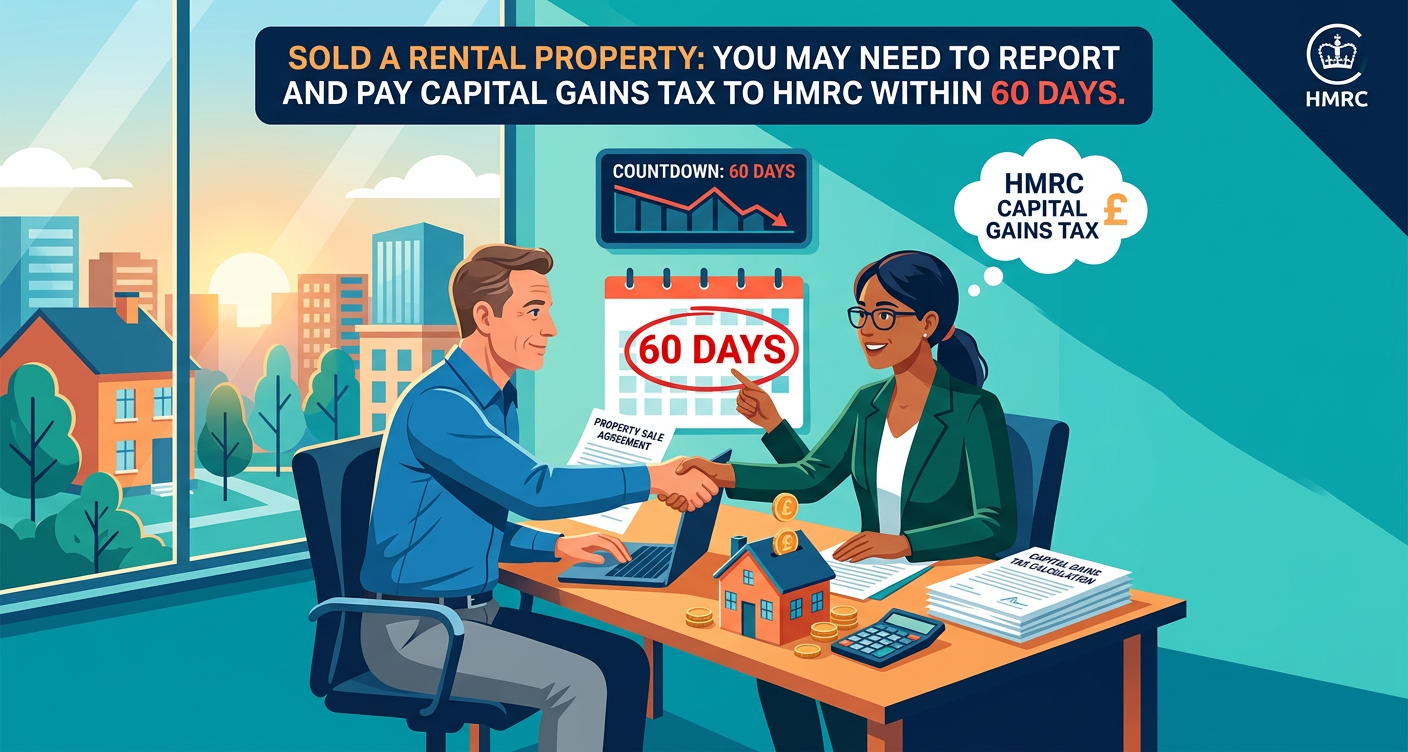
If you sell a rental property in the UK, it is important to understand that you may have a legal obligation to report and pay any Capital Gains Tax (CGT) due to HMRC within 60 days of completion. Many landlords and property owners mistakenly believe that they can wait until they file their Self-Assessment tax return. However, HMRC's 60-day reporting rule means that delays can result in interest charges and penalties.
The rule primarily applies to the sale of residential properties that are not your main residence, including buy-to-let properties, second homes, holiday homes, and certain inherited properties. Understanding your obligations can help you avoid costly mistakes and remain fully compliant with HMRC requirements.
In this guide, we explain exactly how the 60-day CGT reporting rule works, who it applies to, how the tax is calculated, what exemptions exist, and what happens if you miss the deadline.
What Is the 60-Day CGT Reporting Rule?
Since 27 October 2021, residents who dispose of a residential property at a gain have been required to report and pay any Capital Gains Tax owed within 60 days of the completion date. This replaced the earlier 30-day window that had been in place since April 2020.
Crucially, this is a standalone obligation entirely separate from your annual Self-Assessment tax return. Even if you already file a Self-Assessment return each year, you must still submit a dedicated Capital Gains Tax on property return within the 60-day period and pay the estimated tax at that point. Filing your year-end return in January does not satisfy this separate requirement.
Who Does the 60-Day CGT Rule Apply To?
The 60-day CGT reporting requirement applies to UK-resident individuals, trustees, personal representatives, partners in partnerships and limited liability partnerships, and joint owners of property. Similar rules exist for non-UK residents and cover a broader range of disposals, including both residential and non-residential property.
For UK residents, the rules specifically cover direct disposals of residential property where CGT is payable. You will likely need to file a 60-day return if you sell or otherwise dispose of:
• A buy-to-let or rental property
• A second home or holiday let
• A property you have lived in for only part of the period you owned it
• An inherited property sold after a bequest
• A property gifted to a family member (other than a spouse or civil partner)
The rule applies where there is a CGT liability on the disposal. Importantly, it does not apply to indirect interests, such as selling shares in a company that holds residential property those gains are handled through Self-Assessment in the usual way.
Is Your Main Residence Exempt from the 60-Day Rule?
Yes, provided certain conditions are met. If you sell a property that has been your only or main residence throughout the entire period of ownership, you will normally qualify for full Private Residence Relief (PRR). In that case, no CGT is payable and the 60-day reporting obligation does not apply.
However, if you have ever let the property, used it only for part of the time, or if it has served as anything other than your primary home throughout your ownership, you may have a partial gain and the 60-day rule could still apply to that portion. The residential proportion of any mixed-use gain must be reported under the 60-day rules.
No 60-day return is required where:
• The disposal is a no-gain, no-loss transfer between spouses or civil partners
• The entire gain is covered by the annual CGT exempt amount (£3,000 for 2024–25 onwards) or other reliefs
• Capital losses from the same or prior tax years reduce the gain to nil
• The property is sold at a loss
How Is Capital Gains Tax (CGT) Calculated on a Rental Property Sale?
The taxable gain is calculated by deducting the original purchase price and all allowable costs from the sale proceeds. Allowable deductions include:
• The original purchase price
• Stamp Duty Land Tax (SDLT) paid on acquisition
• Solicitor and surveyor fees on both purchase and sale
• Estate agent fees on disposal
• The cost of capital improvements (not ongoing maintenance or repairs)
Mortgage interest and capital repayments cannot be deducted from the gain. Mortgage interest may instead be claimed as a tax credit against rental income under Income Tax rules, but it plays no part in the CGT calculation.
CGT Rates on Residential Property (2025–26)
Residential property gains are taxed at higher rates than other capital assets. From 30 October 2024, the rates are 18% for basic-rate taxpayers and 24% for higher and additional-rate taxpayers. If adding the taxable gain to your total income for the year pushes you across the basic-rate band threshold, the gain may be split part taxed at 18% and the remainder at 24%.
Each individual is also entitled to an annual CGT exempt amount of £3,000 (for the 2024–25 tax year onwards), which can be deducted from the gain before applying the appropriate rate.
How the 60-Day Deadline Works in Practice
· The 60-day reporting and payment deadline starts from the date of legal completion, not the date of exchange of contracts.
· This distinction is important, as many taxpayers mistakenly use the exchange date. For example, if completion takes place on 1 August, the deadline to report and pay any Capital Gains Tax (CGT) is 30 September.
· The CGT return and payment are normally made online through HMRC's Capital Gains Tax on UK property account, accessed via the Government Gateway.
· If you appoint a tax adviser to submit the return on your behalf, you must first authorise them through your online account.
· The authorisation process can take several days, so it is advisable to begin the process as early as possible.
· In cases where HMRC accepts that a digital submission is not possible, a paper Capital Gains Tax on UK property return may be submitted instead.
· HMRC will then issue a 14-digit payment reference number beginning with “X”, which must be quoted when making the payment.
· The amount paid within the 60-day window is treated as a payment on account towards your final CGT liability.
· The final CGT position is determined when you submit your Self-Assessment tax return after the end of the tax year.
At that stage:
- Any overpayment of CGT can be reclaimed.
- Any additional CGT due (for example, because of further gains realised later in the tax year) must be paid by 31 January following the end of the tax year.
How to Report a Property Sale to HMRC
If you have sold a rental property and Capital Gains Tax is due, you will generally need to:
- Calculate your capital gain.
- Create or access a Capital Gains Tax on UK Property Account.
- Submit the property disposal report.
- Pay the estimated Capital Gains Tax within 60 days of completion.
- Include the disposal again on your Self-Assessment tax return if required.
Accurate record-keeping and timely reporting are essential to ensure compliance and avoid unnecessary penalties.
Penalties for Missing the 60-Day CGT Deadline
HMRC takes the 60-day reporting obligation seriously, and the penalties for non-compliance are automatic. An initial fixed penalty of £100 applies if the return is submitted late. If the delay extends beyond six months, a further penalty is charged. Delays of over twelve months attract additional percentage-based fines.
Interest is charged separately on any CGT paid after the 60-day deadline. It is important to note that penalties for late filing apply even where no CGT is ultimately owed a common trap for landlords who assume there is nothing to declare if the gain is small or covered by a relief.
HMRC actively monitors property transactions and regularly issues reminder letters to taxpayers where its records suggest a return may be required. Receiving such a letter after the deadline has already passed leaves you in a difficult position.
Common Mistakes Landlords Make with CGT Reporting
• Assuming the Self-Assessment return covers the obligation. It does not. The 60-day return and the Self-Assessment return are separate filings with different deadlines.
• Counting from exchange, not completion. The 60-day period begins on the completion date, which may be weeks after exchange of contracts.
• Leaving it to January. CGT on property is not payable on 31 January alongside Income Tax. It is due within 60 days of completion.
• Assuming no return is needed if there is no tax to pay. Non-residents in particular are caught by this a return may still be legally required even where the gain is nil.
• Forgetting that gifting counts as a disposal. Transferring a property to a family member (other than a spouse or civil partner) triggers the same CGT rules as a sale at market value.
Reliefs That May Reduce Your CGT Bill
Several reliefs can reduce the CGT payable on a rental property disposal:
• Private Residence Relief (PRR): If the property was your main home for part of the ownership period, PRR may cover a proportion of the gain plus the final nine months of ownership are always treated as a period of residence.
• Annual CGT exempt amount: The first £3,000 of taxable gains is exempt each tax year (2024–25 onwards).
• Capital losses: Losses from other asset disposals including losses brought forward from earlier tax years can be offset against the gain before the rate is applied. Only losses crystallised before the property disposal can be included in the 60-day payment calculation; later losses are picked up in the Self-Assessment return.
It is also worth noting that the Furnished Holiday Lettings (FHL) regime which previously offered more favourable tax treatment for short-term lets was abolished from 6 April 2025. If you hold or are selling a property that was previously classed as an FHL, the standard residential CGT rules now apply.
How Consultax Can Help You Meet the 60-Day Deadline
The 60-day CGT reporting window is short, and the consequences of missing it are real. At Consultax, our chartered accountants work with landlords and property owners to ensure that every disposal is handled correctly and on time. From calculating your precise CGT liability taking into accounts all available reliefs and deductions to filing your Capital Gains Tax on UK property return directly with HMRC on your behalf, we manage the process from start to finish. We help you understand the rules before you complete a sale, not after, so you can avoid unnecessary penalties and make informed decisions about the timing and structure of any disposal.
If you are in the process of selling a rental property, or you have recently completed a sale and are unsure of your obligations, contact Consultax today for professional advice tailored to your circumstances.
Key Takeaways
• The 60-day CGT reporting rule applies to all UK-resident individuals who sell or otherwise dispose of a UK residential property at a gain.
• The obligation arises from the date of completion, not exchange of contracts.
• It is entirely separate from your annual Self-Assessment return filing in January does not satisfy this requirement.
• CGT on residential property is payable at 18% or 24%, depending on your taxable income.
• Your main residence is generally exempt, but rental properties, second homes, and holiday lets are caught by the rules.
• Late filing attracts automatic penalties of £100, rising with further delay, plus interest on any unpaid tax.
• Speak to a qualified accountant as soon as you begin the sale process not after completion.
Conclusion
Selling a rental property can trigger a Capital Gains Tax liability that must be reported to HMRC within 60 days of completion. While many homeowners benefit from Private Residence Relief when selling their main residence, landlords and owners of buy-to-let properties are often subject to the 60-day CGT reporting requirement.
Understanding the rules, calculating your gain accurately, and meeting the reporting deadline are essential steps in avoiding penalties and staying compliant with HMRC regulations. If you are unsure whether the rules apply to your situation, seeking professional tax advice can help ensure that your property sale is handled correctly from the outset.
Start filing Capital Gains Tax returns today
Our UK-based team has helped thousands of businesses with Capital Gains Tax filing. We’re happy to help.
Book a MeetingCategory:
Taxation
Tags:
Expert Accountant, Tax Filing
Comments (0)
No comments yet. Be the first to comment!
Leave Comment