How Accountants Help Law Firms Comply with UK SRA Accounts Rules
Admin
September 25, 2026
0 Comments
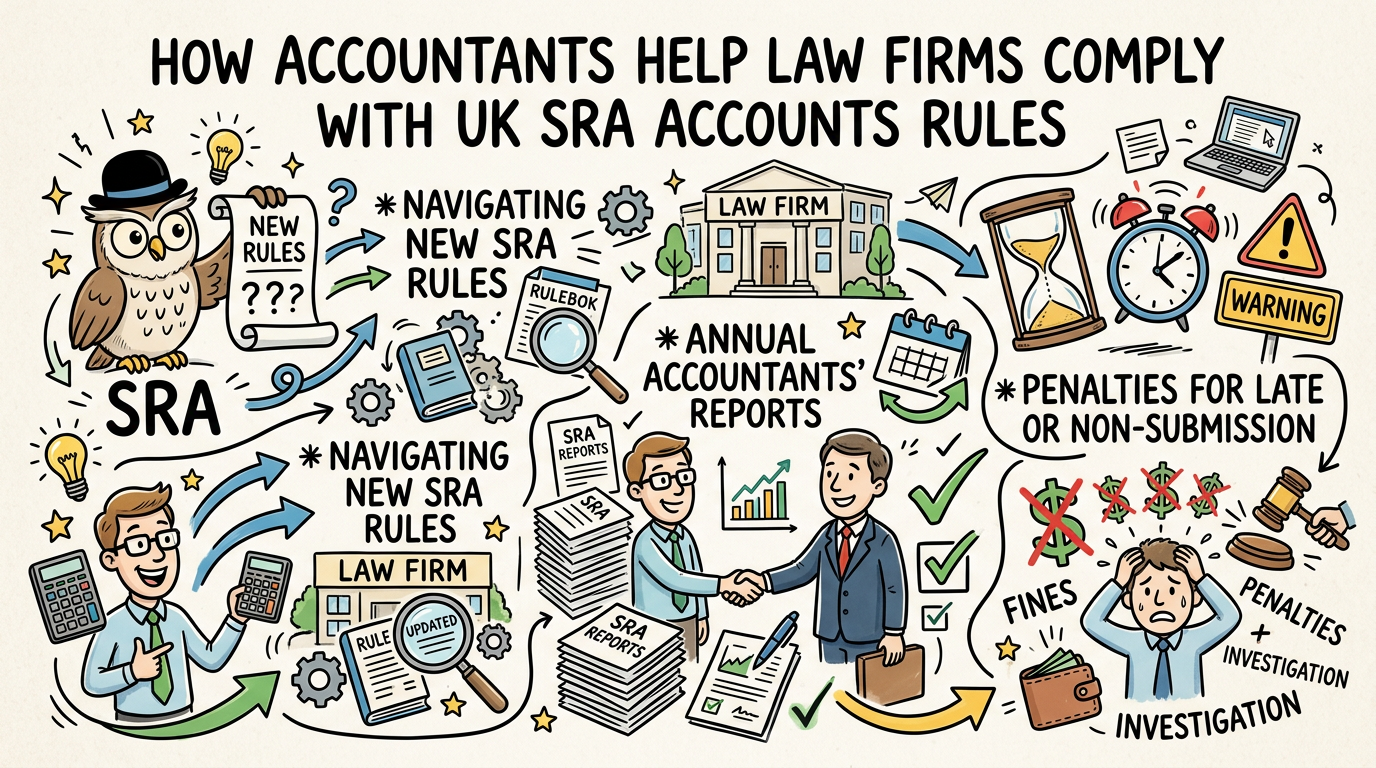
Client money is the single biggest area of regulatory risk for a solicitors' practice. Get it wrong, and a firm risks intervention, fines, or worse. This is why specialist accountants for law firms have become such an essential part of a compliant practice, not just at year end, but throughout the accounting period.
At Consultax Chartered Accountants, we work closely with law firms across the UK to help them meet their obligations under the SRA Accounts Rules with confidence. In this article, we look at what the rules actually require, the changes already on the horizon, and how the right accountant for lawyers can make compliance far less stressful.
What are the SRA Accounts Rules?
The SRA Accounts Rules set out how solicitors and law firms must handle money that belongs to their clients. First introduced in their current, shorter and more flexible form in 2019, the rules exist for one clear purpose: to keep client money safe. More than 7,000 law firms in England and Wales hold client money at any one time, and safeguarding it properly is central to maintaining public trust in the profession.
Part 4 of the rules covers the requirement for most firms holding client money to obtain, and where appropriate deliver, an annual accountant's report. The rules also set out, in detail, how firms must:
• Keep client money in a separate client bank account, distinct from the firm's own business account
• Bank client money promptly on receipt
• Make withdrawals from client account only when properly authorised, and only for the purpose for which the money is held
• Carry out a three-way reconciliation of the client bank account, cash book and client ledger at least every five weeks
• Correct any breach of the rules as soon as it is discovered
• Retain accounting records for at least six years
Firms of every size, from a two-partner high street practice to a large multi-office firm, are expected to have systems and controls in place that meet these standards. The level of scrutiny simply scales with the size and complexity of the firm.

The Accountant's Report: What it Involves
Under Rule 12 of the Accounts Rules, most firms that hold client money must appoint a reporting accountant to prepare an Accountant's Report (known as the AR1). This has to be signed by an accountant who belongs to a recognised chartered accountancy body and who is, or works for, a registered auditor.
The reporting accountant examines the firm's systems, controls and records to check that:
• Client money is being properly safeguarded
• Bank reconciliations are being carried out regularly and reviewed
• Withdrawals from client account are properly authorised
• There is no unexplained shortfall on client account
The report must be obtained within six months of the end of the firm's accounting period. Historically, only a "qualified" report, meaning one that flags significant breach putting client money at risk, has had to be submitted to the SRA. Firms with unqualified reports have simply kept them on file.
A small number of firms can claim exemption from the requirement altogether. This applies where, throughout the accounting period, client money held or received does not exceed an average of £10,000 and a maximum of £250,000, or where the only client money held comes from the Legal Aid Agency.
Rule Changes Already Introduced or Expected Soon
The SRA has been tightening its approach to client money protection in recent years, and firms should be aware of both the rules already in effect and those still to come.
Already in place: anti-money laundering requirements were updated in 2026, and sanctions screening now draws on a new source. Compliance officers are also under closer scrutiny, with an SRA thematic review finding that many firms lack a deputy compliance officer to cover gaps in oversight.
Expected to be introduced from early 2027, subject to approval by the Legal Services Board, is a significant change to the accountant's report regime. Following the collapse of firms such as Axiom Ince, which led to substantial losses of client money, the SRA has proposed that:
Core Updates
• Every firm holding client money will need to submit its annual accountant's report to the SRA, whether qualified or not, rather than only submitting qualified reports as at present
• Firms will need to file a mandatory annual declaration confirming their accounting period, their reporting accountant's details and their exemption status, even where an exemption applies
• Reporting accountants, rather than firms, will submit reports directly to the SRA
• A fixed penalty regime will apply where a declaration or report is not submitted on time
• Larger or higher risk firms, broadly those with a turnover above £600,000 or holding more than £2 million of client money, will need to separate the roles of Compliance Officer for Legal Practice (COLP) and Compliance Officer for Finance and Administration (COFA), so that the same person cannot both run the firm and oversee its compliance
None of this is yet reflected in the current Accounts Rules, so firms should treat it as a direction of travel to prepare for rather than a current obligation. Even so, given how far reaching the changes are, waiting until 2027 to act is unlikely to be a comfortable strategy.
How Accountants for Law Firms Support Compliance
A good accountant does far more than sign off a report once a year. Working with experienced accountants for lawyers throughout the accounting period helps a firm build the kind of evidence trail the SRA expects to see, rather than scrambling to produce it under pressure.
In practice, this support typically covers:
• Setting up robust client accounting systems, so that client and business money are kept properly separate from day one
• Reviewing and testing bank reconciliations, making sure the required three-way reconciliation between client bank account, cash book and client ledger happens at least every five weeks, and is properly reviewed rather than simply filed away
• Supporting the COFA, giving compliance officers a second pair of eyes on systems, controls and the breaches register throughout the year
• Identifying and correcting breaches early, so that minor administrative slips do not become the kind of persistent, unaddressed issue that leads to a qualified report
• Preparing the annual accountant's report, examining client account withdrawals, billing practices, residual balances and record keeping against the standard the SRA expects
• Advising on the exemption thresholds, so smaller firms understand whether they genuinely qualify and what the annual declaration will require of them
• Getting ahead of the 2027 changes, including reviewing whether COLP and COFA responsibilities will need to be separated
Because the Accounts Rules are specific to the legal sector, firms are generally better served by accountants for law firms UK wide with genuine experience of solicitors' practices, rather than a general practice accountant applying standard small business bookkeeping to what is, in reality, a heavily regulated environment with its own vocabulary, deadlines and risk factors.
Why Consultax for your Law Firm's Compliance
We understand that client money compliance sits alongside everything else a law firm has to manage, from fee earning and client care to staffing and cash flow.
• Straightforward SRA Compliance: We help law firms keep SRA Accounts Rules compliance simple and manageable.
• Reconciliation Reviews: We review your client money reconciliation processes to help identify and address potential issues.
• Annual Accountant’s Reports: We can assist with preparing your annual accountant’s report and ensuring the necessary requirements are met.
• Planning for 2027 Changes: We help your firm prepare in advance for changes to the reporting regime expected in 2027.
• Practical Accounting Support: Our team works alongside your firm, understanding the demands of fee earning, client care, staffing and cash flow.
• Tailored Guidance: Whether you need a review of your existing processes or ongoing accounting support, our accountants for lawyers can help you identify and address potential issues.
• Get in Touch: If you would like to discuss where your firm currently stands, contact Consultax Chartered Accountants through our contact form and a member of our team will be in touch.
Conclusion
The SRA Accounts Rules exist to protect client money, and the direction of travel is towards greater transparency and tighter reporting, not less. Firms that build strong systems, carry out regular reconciliations, and work with accountants who understand the legal sector are far better placed to meet both today's requirements and the changes expected from 2027 onwards. Getting the right support in place now, rather than waiting for the new rules to land, is the surest way to keep client money safe and your firm firmly on the right side of the regulator.
Is your firm compliant with the upcoming 2027 SRA accounting rules?
Contact us today to ensure your law firm stays fully compliant.
Book a MeetingCategory:
Accounting
Tags:
Accounting, Expert Accountant
Related Articles


Comments (0)
No comments yet. Be the first to comment!
Leave Comment